My Place at the Table
“Queering the Crip, Cripping the Queer”
Text: Kenny Fries
I am accustomed to being the only queer disabled person in the room. Most of the time, in queer spaces I’m the only person with a disability, and when in a disabled space, I am the only queer. As used to these situations as I’ve become, sometimes this situation is untenable.
In 2015, I was invited to read from my work for an event for the large and historic “Homosexuality_ies” exhibit at the Deutsches Historisches Museum and Schwules Museum in Berlin. Before my reading, I went to experience the exhibit and found there were inaccessible places in the exhibit where my wheelchair could not fit. The exhibit texts were too high on the wall for me to read. I was at a groundbreaking, and government-funded, exhibit and I could not completely access it. Worse, there were only two minor representations of disability and disabled persons in the entire two-museum exhibit.
Access is not only physical access. As necessary as physical access is, access must always include disability representation by disabled artists, not only in disability focused projects, but, dare I say, in all projects.
So, at my event, before I read from my work, I briefly but very clearly addressed this inaccessibility. What I didn't know was that Birgit Bosold, one of the curators of "Homosexuality_ies," and member of the Schwules Museum Board of Directors, was there, and would introduce me. After my reading, Birgit came over to me and said, “we should talk.” And we did. When we talked, Birgit said to me, “You were right.” I suggested we curate an exhibit on queer/disability at the Schwules Museum. Thus, started not only “Queering the Crip” but also a valued friendship.
When the “Homosexuality_ies” exhibit moved to Münster, some disability representation was included. More importantly, the conversation I had with Birgit led to our curating “Queering the Crip, Cripping the Queer,” the first international exhibit on queer/disability history, activism, and culture, which opened at the Schwules Museum Berlin in September 2022 and was extended through May 2023. The exhibit (the title comes from an article by U.S. disability studies scholar Carrie Sandahl) included the work of over twenty international artists whose work spoke back to the history and historical objects we included in the exhibit.
Acess in Form and Content
Access at “Queering the Crip, Cripping the Queer” was essential to both the content and design of the exhibit. Included on the curatorial team was Kate Brehme, who was both in charge of accessibility and a curator who was instrumental in the creative choices we made. Practical access for the exhibit included all texts, objects, and art at “wheelchair height,” including exhibit texts on accessible shelves; larger font used for texts; a floor guide, in tandem with an audio guide in both English and German, led blind and visitors with low vision through the exhibit; tactile exhibit map; 3D models with audio description for artworks/objects; captions for all videos; section texts in simple language; video guide in sign language; exhibit tours in sign language; exhibit tours for blind and those with low vision; accessible extended exhibit website; captioned virtual curatorial tour on website; exhibit events were both live and streamed with sign language interpretation.
Perhaps more importantly almost all of the artists in “Queering the Crip” identified as both queer and disabled.
“The Ideal Body“ and The “Perfection of Society“
Curated around the theme of “the ideal body,“ this contemporary work was presented in an historical context. Moving from ancient Greek culture to the present, the exhibit looked at both the fantasy of “the ideal body” and how society, and sometimes queer and disabled people themselves, acquiesced to this so-called “ideal.” As much as “the ideal body” is deemed beautiful, this also creates an oppressive “norm” that actually does not exist.
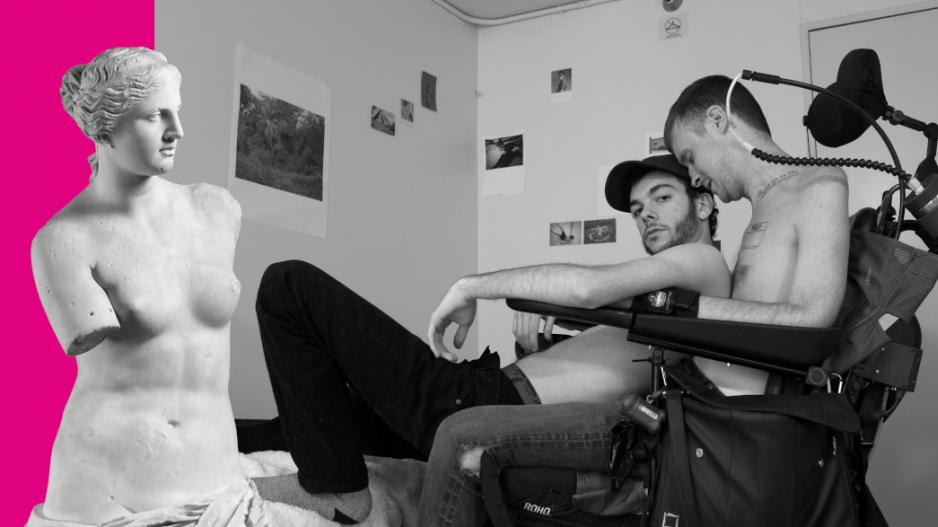
“Queering the Crip, Cripping the Queer” was presented in nine chapters, opening with “The Ideal Body,” which featured actual-sized plaster casts of Greek statues including the famous Venus de Milo. Disability studies scholar Lennard J. Davis has described the Venus de Milo:
From the Greeks the exhibit moved to “Saints and Sinners,” which looked at the Middle Ages, when impairments were considered either a divine punishment, the devil’s work, or a special distinction. The institutionalization of the disabled began and queer people, especially women deemed as “witches,” were often burned at the stake. Countering this history was an interview with Scottish performer/choreographer Claire Cunningham with excerpts from her solo performance “Reason to Live,” based on the drawings of Hieronymus Bosch.
Then, in “The Power of Depiction,” we looked at how in Renaissance art, the Greek “ideal” reemerged. Physiognomy was prevalent. Composed of the Greek words for “nature” and “judge,” physiognomy is a belief one could judge a person’s character by their outward appearance. A famous example: Shakespeare’s Richard III, whose disability was not extreme in real life, became a symbol of evil.
In art, idealized bodies were celebrated, while disabled people were portrayed as objects of fascination, scientific research, or as figures of fun. Even today, physiognomy continues to reign: for example, villains in movies are often disabled. Disability studies scholar Vicki Lewis writes, “Consider the ease with which good and evil can be portrayed by the addition of a hook, a wooden leg, or an eye patch. Introductory screenwriting manuals even recommend that aspiring writers give their villain a limp or an amputated limb.”
But today, a truer counter-narrative is emerging: queer disabled artists such as U.S. painter Riva Lehrer and U.S. photographer Joey Solomon celebrate their bodies and their lives.
“Perfecting…,” the next chapter took on the Enlightenment, a time which brought to the fore two major ideas. One is the idea of freedom and equality. The other is the belief that reason should be the standard of social and personal action, that scientific rationality could perfect society by solving all its troubles and create an ideal society. Both concepts were paradoxical, since the vast majority of people were excluded from rights and considered incapable of rationally using their own minds. Columnist Jamelle Bouie writes: “At its heart, the movement contained a paradox: Ideas of human freedom and individual rights took root in nations that held other human beings in bondage and were then in the process of exterminating native populations. Colonial domination and expropriation marched hand in hand with the spread of ‘liberty,’ and liberalism arose alongside our modern notions of race and racism.”
Today, we are still enmeshed in the Enlightenment paradox as we struggle to “perfect” society based on less exclusive ideas. Samoan/Pākehā artist Pelenakeke Brown, in prints from her “grasp + release” series, reclaims her medical records by creating texts redacting oppressive terminology of perfection, taking ownership of her body’s history.
Queer and Disabled Histories
Queer and disabled histories, though similar, were not often parallel. But during the 19th century queer/crip history merged. We curated “Enforcing/Resisting ‘Normalcy’” to show how medical science increasingly gained power. Methods were used to measure humans and define “norms” and “normality.” The concept of “the homosexual” and “the disabled” entered the lexicon. Same-sex desire, gender nonconformity, and disabilities went from being characteristics to identities, leading to both community building and stigmatization. “Scientific” efforts intensified. Eugenics popularized a new set of beliefs and practices for the “improvement” of society. People were classified as carriers of “desirable” or “undesirable,” and supposedly inherited, traits. Reproductive and sexual behavior was to be controlled so that “undesirable” traits were “bred out” by preventing reproduction. At the same time, however, new movements emerged against such repression. People with disabilities, queer people, and feminists fought for equal rights as well as sexual and reproductive self-determination.
This part of the exhibit included two videos by TJ Cuthand. Canadian poet and interdisciplinary artist Sandra Alland writes, “Cuthand, of Plains Cree and Scots descent and member of Little Pine First Nation, documents personal experience mixed with/against history. In Madness in Four Actions, he uses footage from the Academy Award winning film The Miracle Worker connecting the institutional abuse of deafblind Helen Keller with the bipolar disorder diagnoses of actress Patty Duke—and himself. Looped clips of Duke/Keller being restrained and struck are overlaid with text about abuses in psychiatry, including connections between Nazis and Canada’s mental health system.”
Which brings us to what I’ve called the “dark heart” of the exhibit. “Elimination” presents what happened when the Nazis took power in Germany. Eugenics became law. Eugenicist Ernst Haeckel’s belief, “politics is applied biology,” was realized. Queers and the disabled were increasingly persecuted. Some queers and numerous disabled people were forcibly sterilized. By 1945, about 400,000 people were sterilized against their will according to decisions made by “hereditary health courts.” Disabled children were registered and sent to “Hospitals for Special Care,” where they were experimented on and killed by injection or starvation.
On September 1, 1939, Germany invaded Poland, beginning World War II. The Nazi government commenced the Aktion T4 program, and a few months later, the mass murdering of disabled people in gas chambers began. In 1941, after the official end of Aktion T4, the murders continued by both gas and other means. The disabled, like other groups viewed as weakening the Reich, were deemed “useless eaters” and “unworthy of life.”
Of “The Unrelenting,” her three-part project that begins with the large black triangle hung outside the museum, Elizabeth Sweeney, a neurodivergent visual artist, arts researcher, and curator of Acadian descent, says “Many of us must still fight against sanctioned shaming, segregation, and persecution.” Originally shown in the Drake Hotel in the Queen West neighborhood of Toronto, Sweeney was intrigued by the similarities of that neighborhood’s history to that of the Schwules Museum. The symbol of the black triangle, “a badge used by the Nazis to label, shame, and persecute a large and diverse group of people, intends to mark both a taking up and a taking back of space around the Schwules Museum. It is a call to those who live with these labels, especially those who historically called the neighborhood home, and have been displaced by its gentrification.” The curators envisioned all of us who passed the triangle to reach the exhibit joining in solidarity with the black triangle community, free of shame and stigma.
Out of the Ashes and into the Future
“Queering the Crip, Cripping the Queer,” continued with “Our Icons,” a chapter which presented German choreographer/performer Raimund Hoghe (1949-2021), German artist/performer Lorenza Böttner (1959-1994), and African American writer Audre Lorde (1934-1992), as examples of how, just decades after Nazism persecuted and killed too many queer/disabled people, these iconic queer/disabled artists used their queer/disabled bodies as a site of opposition and transformation, becoming beloved mentors for generations of queer/disabled artists.
The exhibit closed with “Freak Out,” illuminating how queer/disabled artists and activists, beginning in the 1970s, showed how societal barriers, both physical and attitudinal, were the cause of disablement. Their message thus resembles that of Rosa von Praunheim’s iconic film It is Not the Homosexual Who is Perverse But the Society in which He Lives (1971), which kicked off queer liberation in West Germany.
Pointing toward the future is the Disability Justice Movement, initiated by Patty Berne, Mia Mingus, and Stacey Park, queer/disabled women of color who felt excluded from the disability rights movement, disability studies, and by ableism in activist spaces. Working in the San Francisco Bay Area, they focused on the intersectionality of disability/ableism with other identities/oppressions such as race, class, and gender.
This future is manifested in Canadian artist Syrus Marcus Ware’s multi-channel video “Ancestors, Can You Read Us? (Dispatches from the Future),” an “imagined and staged dialogue with a future beyond the current epoch of Black social death and insecurity and this time marked by the ever-present capitalist forces of greed and the persistent script of police and state violence.” Ware’s video provides sustenance as queer/disabled people continue to find power both in society and in our individual lives.
My Place at the Table
Though I was the only queer/disabled person on the curatorial team, the other team members were either queer or disabled. In this position, I held both the queer and disabled perspectives to guide the exhibit’s curation.
Often, I was asked to explain how certain queer parts of the exhibit related to disability. I was able to make the connection between the “ugly laws,” which banned disabled people from being in public, that were omnipresent in the U.S. and elsewhere in the latter 19th century (the last U.S. “ugly law” wasn’t repealed until 1974), with Paragraph 175, the German anti-homosexuality law. Paragraph 175 was ostensibly to protect younger men from the “predation” of older men. But case histories show it was the offense to public morals that was actually the main offense. Thus, both disabled people and gay men were prohibited by law to offend public morals.
Similarly, the exhibit included the work of HIV+ artists Charles Ryan Long and Brontez Purnell. How does HIV historically relate to disability? Because of my experience living in San Francisco at the peak of the HIV/AIDS pandemic in the 1980s and early 1990s, I knew how many with HIV learned from disabled folks about how best to navigate the government and medical bureaucracies to get the assistance they needed. I also knew firsthand how disability, historically a symbol for mortality and death, now encompassed those with HIV.
I also personally felt how the writing of Audre Lorde, especially in The Cancer Journals and in A Burst of Light, brought together the queer and the disabled. That Lorde had spent time in Berlin, and was an important figure to the Afro-German and German feminist movements, made her an essential part of the exhibit.
It was fortuitous that Birgit and our researcher Sydney Ramirez, found in a 1984 interview, something Lorde said about a feminist book fair in London “held in a room that was inaccessible to disabled people.” Lorde noticed, “At the bottom of insurmountable steps, a petition was passed around expressing a complaint about it.” She was concerned “that so many women did not sign it.” Lorde observed this “and wondered why they would even want to participate in a feminist book fair.” She asked: “What are they trying to find out here if they already can’t see such a connection? This was a book fair that was not accessible to women with walking disabilities and all they were supposed to do was take a stand and put their name down.”
In the interview, Lorde goes on to say that this situation “could only happen because there was no disabled woman in the preparatory committee and therefore the question simply did not come up. What matters to me is that we broaden our awareness in such a way that no disabled woman or black woman needs to be in the preparation group for this.”
I strongly related to Lorde’s prescient words. On numerous panels, juries, and committees, I’ve too often been the only disabled and/or queer person at the table. At countless readings, conferences, and bars, I’ve been the only one present, as well.
As important as physical access is, what is often forgotten is the cultural representation of disability, and especially queer/disability. Though queer/disability stories can be found as early as ancient Greece (the blind prophet Tiresias lived as both a man and a woman during his mythic lifetime and is often depicted as gay, non-binary, or as a woman, in many productions of the Oedipus plays) it is not usual to encounter our stories in museums, theaters, or in our literature.
Even during the Nazi Reich in Germany, when both queers and the disabled were persecuted, sterilized, and murdered, stories about queer/disabled people during that time are not easy to find. In the exhibit we highlighted two such stories, most importantly that of Hans Heinrich Festersen, who was hanged at Berlin’s Plötzensee prison in 1943, and whose letters written from prison to his sister Ruth are in the archive of the Schwules Museum.
The queer/disabled artists, and the queer/disability stories we featured in “Queering the Crip, Cripping the Queer” are really just the tip of the iceberg. The exhibit offered many avenues of research and art to pursue in other exhibits, formats, and venues.
When Nina Mühlemann, a Swiss queer/disabled performer, scholar, and activist, came to “Queering the Crip, Cripping the Queer,” she texted to me that the exhibit was “so us,” I knew we had created a welcoming and accessible space that I had longed for but had not yet experienced.
But Lorde’s words remain. Would this have happened if there was not a queer/disabled person with agency in the room?
About the author
Kenny Fries curated “Queering the Crip, Cripping the Queer,” the first international exhibit on queer/disability history, activism, and culture (Schwules Museum Berlin) , as well as the online exhibit “A Picture of Health: Jo Spence, a Politics of Disability and Illness.” He is the author of In the Province of the Gods (Creative Capital Literature Award); The History of My Shoes and the Evolution of Darwin’s Theory (Outstanding Book Award, Gustavus Myers Center for the Study of Bigotry and Human Rights); and Body, Remember: A Memoir. His books of poems include In the Gardens of Japan, Desert Walking, and Anesthesia. Returns: Poems Selected and New will be published in June 2026. Twice a Fulbright Scholar (Japan and Germany), he has received a Rockefeller Foundation Bellagio Center Arts and Literary Arts Fellowship, was a Creative Arts Fellow of the Japan/US Friendship Commission and the National Endowment for the Arts, and a Cultural Vistas/Heinrich Böll Foundation DAICOR Fellow for diverse and inclusive transatlantic public remembrance. He has received grants from the DAAD (German Academic Exchange), Berlin Senate, Culture Moves Europe, British Art Network, and Canada Council for the Arts. His current work-in-progress is Stumbling over History: Disability and the Holocaust, excerpts of which have been in The New York Times, The Believer, and Craft, as well as featured in his video series What Happened Here in the Summer of 1940? He is a Disability Futures Fellow of the Ford Foundation/Mellon Foundation/USA Artists.